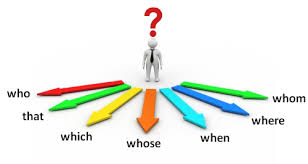
Today we'll be dealing with relative clauses. Please, click on the picture below to start.
jueves, 3 de abril de 2014

viernes, 28 de marzo de 2014
What is cockney rhyming slang?
Hi guys! I assume you've all got the text we're going to work with. In case you don't, you can get it HERE.
Ok, now, read it carefully and answer the following questions afterwards:
a) Originally, what part of London did Cockneys live?
b) What is the original meaning of the word cockney?
c) What does the rhyming slang cosnsit of?
d) Why did the rhyming phrases often lose the second (or rhyming) part?
e) Is cockney rhyming still used nowadays? What is the trend today?

Now, have a look at the examples in the text and try to provide a translation into standard English as follows:
I can't open the door! I'm talking on the dog!!! >> I'm talking on the phone (dog and bone = phone)
a) I need to buy a new pair of one's for the party.
b) Turn the custard off and let's get to work!
c) Use your loaf to work out the problem.
d) She is the twist I like.
e) If we don't get home on time we'll get into big barney!
f) The kids are in the bedroom: just go up the apples over there
Ok, now, read it carefully and answer the following questions afterwards:
a) Originally, what part of London did Cockneys live?
b) What is the original meaning of the word cockney?
c) What does the rhyming slang cosnsit of?
d) Why did the rhyming phrases often lose the second (or rhyming) part?
e) Is cockney rhyming still used nowadays? What is the trend today?
Now, have a look at the examples in the text and try to provide a translation into standard English as follows:
I can't open the door! I'm talking on the dog!!! >> I'm talking on the phone (dog and bone = phone)
a) I need to buy a new pair of one's for the party.
b) Turn the custard off and let's get to work!
c) Use your loaf to work out the problem.
d) She is the twist I like.
e) If we don't get home on time we'll get into big barney!
f) The kids are in the bedroom: just go up the apples over there
martes, 18 de marzo de 2014
The tune everybody sings along
Pharrell Williams is an American musician, singer, songwriter, record producer and, nowadays, the man with the golden touch. Every single song he's taken part in has become an instant hit, as it happened to Daft Punk's Get lucky or Thicke's Blurred lines. But this year he's made it with his very own worldwide hit Happy
So, let's get to it. First of all the very typical gap filling exercise. You can download the gapped lyrics worksheet right below:
lunes, 10 de marzo de 2014
#quenipintado TIPS
Last week we decided to start working on the Platero-Greco mashup. That's fine! Let's go for it!
I want to give you some tips to get on with your work. Remember, there are only a few guidelines that you must follow:
a) You have to refer to both Platero and I and El Greco - how you do it is completely up to you...
b) English is the language to be used.
c) You should carry out your projects in groups (team work!)
d) You should issue, spread, advertise, publicize, broadcast, promote your work online, especially on social networks. Remember, the tags to be used (on Twitter, Instagram or anywhere else) are #quenipintado (the project hashtag) and #fiii4a (our own)
The rest - what to do (text+illustrations, mural, comic, video, song lyrics, paintings, drawings, photographs), how to do it (digital works or handcraft), doing with or without ICTs - depends on you and just you.

As for this week, we just agreed to create a (powerful) image where both Platero and El Greco would be present. It'd be great to add a short text in English to illustrate the pic. You can either use your own or get it out of Juan Ramón Jiménez's novel (the English translation, of course). Pictures can be digital or you can also choose to work with your hands and take a photograph of your work when you finish. Once you get it done, upload your picture to the blog, Twitter and/or Instagram (don't forget the hashtags!)I want to give you some tips to get on with your work. Remember, there are only a few guidelines that you must follow:
a) You have to refer to both Platero and I and El Greco - how you do it is completely up to you...
b) English is the language to be used.
c) You should carry out your projects in groups (team work!)
d) You should issue, spread, advertise, publicize, broadcast, promote your work online, especially on social networks. Remember, the tags to be used (on Twitter, Instagram or anywhere else) are #quenipintado (the project hashtag) and #fiii4a (our own)
The rest - what to do (text+illustrations, mural, comic, video, song lyrics, paintings, drawings, photographs), how to do it (digital works or handcraft), doing with or without ICTs - depends on you and just you.
I'll give you some links to resources you might find useful. There we go!
- Free online bilingual edition of Platero y yo / Platero and I. You can also try this version, entirely in English.
You can edit your pictures using apps, webapps or software.
One of the best photo editors software is Adobe Photoshop, but you should take into account it is not free (you can download a trial version that will allow you to use it for some days, though) and it's a little bit complex, too. However there are free alternatives; the best one is Gimp, free, easier to use and quite professional (I'm sure most of you are familiar with it)
Yo can also edit your picture on the Internet using free online webapps. Here's a bunch of good ones:
- Picadilo
- Pixlr
- Sumopaint
- PicMonkey
- Picfull
Regarding smartphones and tablets, there are thousands of apps available either for iPhone or Android, and you're all probably using them on a regular basis, so... Anyway, my favourite is Snapseed (free and ready to download both on iTunes and Google Play)
And, even though I provided this link in the previous post, I'd like to remind you here's a bank of resources to find any kind of information you might need about El Greco and Platero: Platero que ni pintado Wix
So, guys, let's get right on it! We'll be waiting for your pics!
martes, 25 de febrero de 2014
Celebrando aniversarios: Platero #quenipintado

Para celebrar estos dos acontecimientos cómo merecen y de una forma original, se os propone participar en un mash-up en el que, por grupos, tendréis que contar la historia de Platero (entera o centrándoos en capítulos independientes) utilizando imágenes de El Greco. Puede parecer una locura, pero ahí está el reto...
Podéis utilizar los recursos que queráis - en la web proponen una serie de recursos online para realizar cómics, vídeos, murales, etc - pero también podréis realizar el trabajo sin utilizar TICs. Lo que sí que sería necesario es que el resultado final quede publicado de alguna manera en internet, para que todos podamos verlo (si surge alguna duda en este respecto, los profesores que coordinemos el trabajo os iremos asesorando). También podéis hacer a todo el mundo partícipe del progreso de vuestros trabajos en Twitter utilizando el hashtag #quenipintado
El plazo de realización y presentación de los proyectos es flexible, pero sería ideal que todo estuviera listo para el 23 de abril (Día del libro), para poder presentar vuestros trabajos en la feria del libro del centro.
Para más información, poneos en contacto con vuestros profesores de lengua y/o plástico o conmigo mismo.
Animaos y dad rienda suelta a vuestra imaginación.
miércoles, 29 de enero de 2014
Vines for peace
Tomorrow, 30th January, it's the School Day of Non-violence and Peace. Some students from 1 ESO-A and 2 ESO-A, together with two Art teachers and one English teacher made this 6 sec-long videos which are our particular contribution to this celebration. All videos were made with Vine, a very popular app to make up home made short videos and to share them online. We hope you enjoy them.
>
|
   |
miércoles, 30 de octubre de 2013
Jack o'Lantern

The term jack o’lantern was first applied not to pumpkins, but people. In 1663, the term meant a man with a lantern, or a night watchman. Just a decade later, it began to be used to refer to the mysterious lights sometimes seen at night over, swamps, and marshes.These ghost lights— called jack-o’-lanterns, hinkypunks, hobby lanterns, corpse candles, fairy lights, will-o'-the-wisps, and fool's fire—are created by gases from decomposing plant matter. For centuries before there was this scientific explanation, people told stories to explain the mysterious lights. In Ireland those stories often involved a guy named Jack.Stingy Jack, was a blacksmith who invited the Devil to join him for a drink. Stingy Jack didn't want to pay for the drinks from his own pocket, and convinced the Devil to turn himself into a coin that could be used to pay for the drinks. The Devil did so, but Jack didin't use the coin to pay the bill but kept the Devil-coin in his pocket with a silver cross so the Devil couldn’t turn back to his original form. Jack eventually let the Devil loose, but made him promise that he wouldn’t look for revenge on Jack, and wouldn’t claim his soul when he died.Later, Jack annoyed the Devil again by convincing him to climb up a tree to pick some fruit, and then carved a cross in the trunk so the Devil couldn’t climb back down (the Devil is, apparently, an idiot). Jack set him free again, on the condition that the Devil once again not take revenge and not claim Jack’s soul.When Stingy Jack died, God didn't allow him into Heaven, and the Devil, keeping his word, refused to accept Jack’s soul in Hell. Instead, the Devil gave him a single burning coal to light his way and sent him off into the night to “find his own Hell.” Jack put the coal into a carved turnip and has been roaming the Earth with it ever since. In Ireland people say that the ghost lights in the swamps are Jack’s improvised lantern moving around and he and the lights were named "Jack of the Lantern," or "Jack O'Lantern."

Suscribirse a:
Comentarios (Atom)